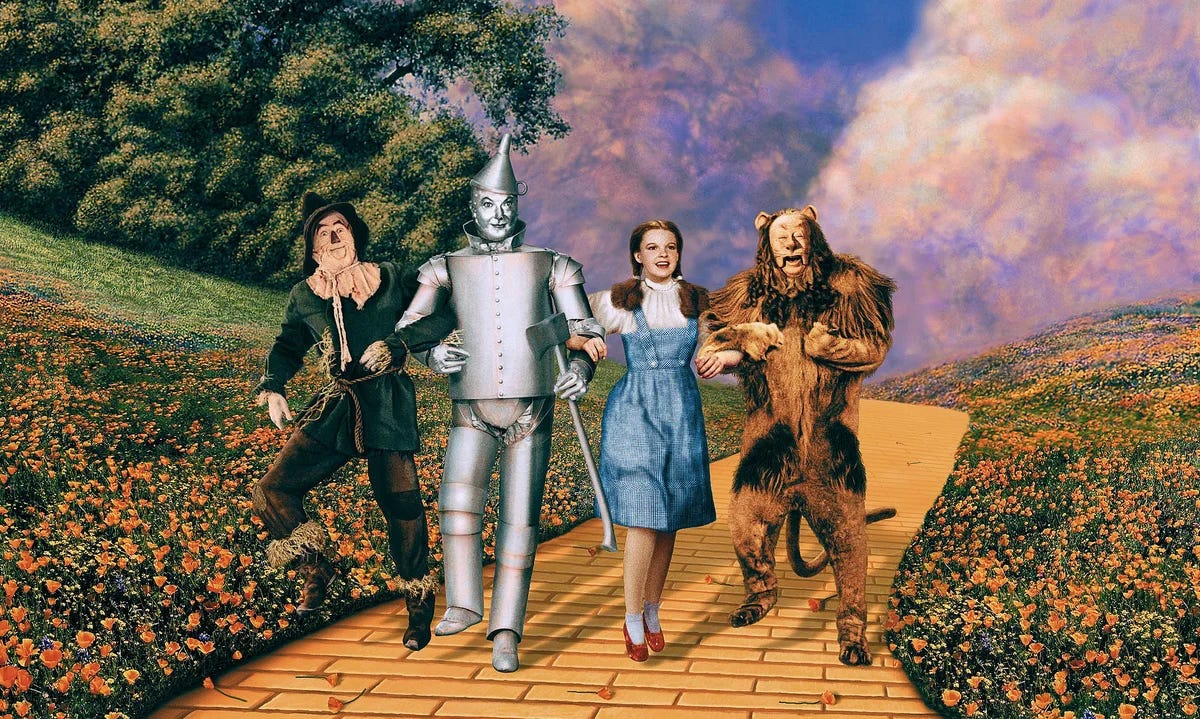
In 1939, the American media company Metro-Goldwyn-Mayer (MGM) produced an extraordinarily imaginative musical fantasy film adaptation of L. Frank Baum’s 1900 children’s fantasy novel, The Wonderful Wizard of Oz.
Notable for its use of Technicolor (a technique using a color motion picture process dating back to 1916 that provides a particularly surreal quality to this film), unforgettable characters, fantastic storyline, and a memorable musical score.
The film stars Judy Garland, Frank Morgan, Ray Bolger, Bert Lahr, Jack Haley, Margaret Hamilton, and Billie Burke withFrank Morgan appearing as the “Wizard” of Oz.
The Wizard of Oz first premiered at the Orpheum Theatre in Green Bay, Wisconsin, on August 10, 1939 (after a “sneak preview” held in San Bernardino, California), followed by the Hollywood, California, premiere at the world-famous Grauman’s Chinese Theatre on August 15, 1939, and the New York City premiere at Loew’s Capitol Theatre, on August 17, 1939.
On August 25, 1939, the film opened in theaters all across America.
Though not an immediate financial nor critical success, The Wizard of Oz has gone on to become one of the most enduring and beloved family films in cinema history, in the 8+ decades since its release.
Receiving six Academy Award nominations for “Best Picture,” “Best Cinematography” (color), “Best Special Effects,” “Best Art Direction,” “Best Original Score,” and “Best Original Song” (“[Somewhere] Over the Rainbow”), The Wizard won Oscars for both “Best Score” and “Best Song.”
Deemed “culturally, historically, and aesthetically significant” to America’s film heritage, it was one of the first films selected for inclusion in the Library of Congress’ National Film Registry in 1989.
Furthermore, according to the US Library of Congress exhibition, The Wizard of Oz: an American Fairy Tale (established in 2010), “The Wonderful Wizard of Oz is America’s greatest and best-loved home-grown fairytale.”
According to a study conducted by the University of Turin, Italy, to measure the success and significance of 47,000 films from around the world, in 2018, The Wizard of Oz was named the “most influential film of all time.”
In 2022, the film was ranked 2nd in Variety’s inaugural list of “The 100 Greatest Movies of All Time.”
Concept and Production
Production on The Wizard of Oz began after Walt Disney’s Snow White and the Seven Dwarfs (made in 1937) proved that films adapted from popular children’s stories and fairytales could be box-office hits.
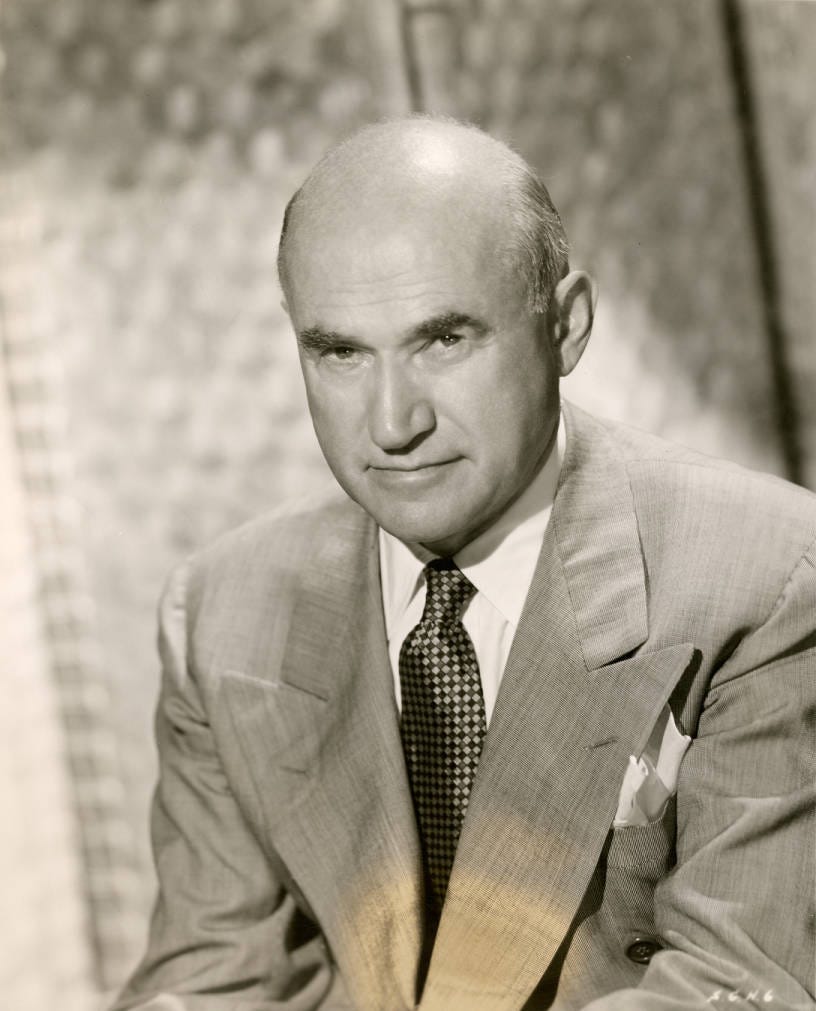
In January of 1938, MGM (Metro-Goldwyn-Mayer) purchased the rights to L. Frank Baum’s popular novel, The Wonderful Wizard of Oz, from American film industry pioneer Samuel Goldwyn. Goldwyn had considered making the film as a vehicle for actor/singer/comedian Eddie Cantor (already under contract to Samuel Goldwyn Productions), whom Goldwyn envisioned playing the part of the “Scarecrow.”
After seeing drafts from a number of renowned screenwriters (including Herman J. Mankiewicz, Noel Langley, [poet] Frederic Ogden Nash, Florence Ryerson, and Edgar Allan Woolf), MGM producer Arthur Freed assigned the screenplay to Noel Langley. During filming, however, director Victor Fleming and writer John Lee Mahin revised the script, adding and cutting scenes.
Jack Haley, who would play farmhand “Hickory” and the “Tin Man,” and Bert Lahr, who would play farmhand “Zeke” and the “Cowardly Lion,” are also known to have written some of their own dialogue for the Kansas sequences.
After more than a dozen revisions, on October 8, 1938, the “working” draft of the script was completed, with further rewrites and revisions occurring long into production.
Those known to have subsequently contributed to the final product (but received no writing credit) included: Irving Brecher, Jack Mintz, Herbert Fields, Yip Harburg, Arthur Freed, Richard Thorpe, Samuel Hoffenstein, Sid Silvers, King Vidor, and George Cukor. Only Langley, Ryerson, and Woolf received official credit.
Casting
Even before the “working” draft of The Wizard of Oz was complete, casting became problematic.
Shirley Temple (who was under contract with 20th Century Fox) was first to be considered for the role of Dorothy, followed by Canadian-born actress and singer Deanna Durbin. But ultimately, Judy Garland (the most experienced of the three) was chosen because she had no previous contractual obligations.
Stage performer/professional dancer Ray Bolger was originally cast as the “Tin Man” (and farmhand “Hunk”), and fellow “hoofer” Buddy Ebsen was set to play the “Scarecrow” (and farmhand “Hickory”), but Bolger convinced producer Mervyn LeRoy that he’d make a better “Scarecrow,” and since Ebsen made no protest against the role reversal, the parts were switched.
However, ten days into shooting, Ebsen suffered a severe allergic reaction to the aluminum dust from his costume, and had to be replaced by drummer/actor, Jack Haley.
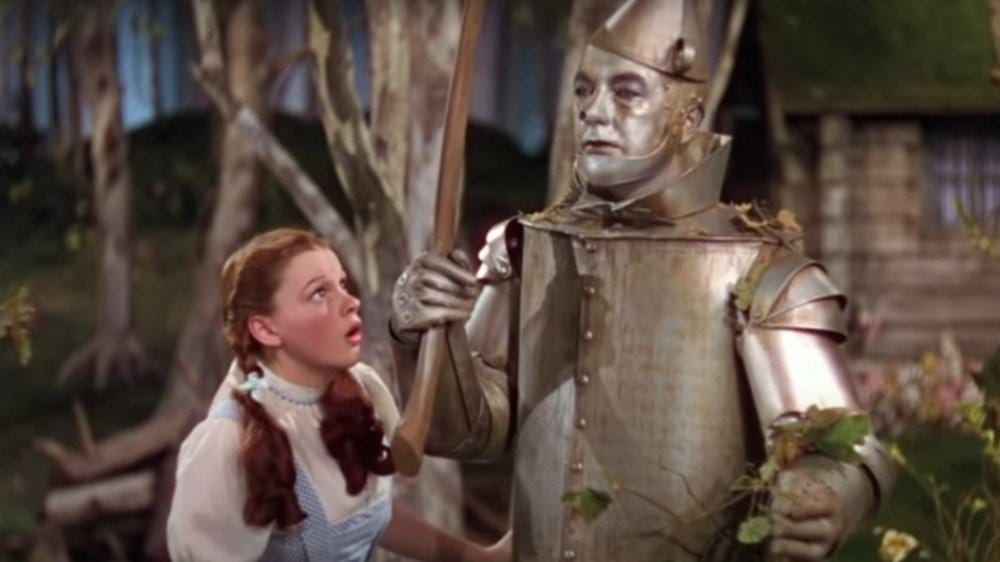
Initially approaching well-known actor Ed Winn to play the part of “The Wizard” (who turned it down, saying the part was “too small”), famed comedian W. C. Fields was then offered the part–but the studio couldn’t afford the fee Fields demanded. Meanwhile, the highly accomplished and popular actor Wallace Beery lobbied for the role, but the studio refused to release him from his other projects.
Finally, after weeks of having no title role character (and no “Professor Marvel”), the studio gave the parts to veteran silent film star Frank Morgan.
American glamour actress Gale Sondergaard was originally cast to play “Almira Gulch” and the “Wicked Witch of the West,” but withdrew from the role when she realized she’d be acting most of the film as an “ugly, green hag.”
Just three days before filming began, MGM contract-actress Margaret Hamilton was chosen to replace Sondergaard. Upon seeing Hamilton’s test shots, MGM knew she should have been their first choice.
For the film adaptation, screenwriter Noel Langley envisioned a much different “Cowardly Lion” than the one in the original book. Essentially working backwards, after Broadway star Bert Lahr agreed to take on the part, Langley began incorporating Lahr’s trademark mannerisms into the script. On the set, director Victor Fleming encouraged Lahr to improvise comedic lines to enliven his character, as well as his now iconic roar.
To his credit, Lahr essentially created a character that could both run on all fours and walk upright, while donning an extremely hot costume, much of which was made from actual animal fur.
Finally, once American Broadway actress Billie Burke agreed to play “Glinda, the Good Witch of the North,” stage and film actor Charley Grapewin was chosen to play “Uncle Henry,” character actress Clara Blandick was signed to play Dorothy’s “Aunt Em,” actor Pat Walshe signed on to play “Nikko, the Head Winged-Monkey,” and the popular vaudevillian group Singer’s Midgets were signed to play the “Munchkins,” filming began.
Actors Who Received No Credit:
Mitchell Lewis, as the “Winkie Guard Captain” (though he had a speaking part).
Adriana Caselotti (the voice of “Snow White” in the Disney film, Snow White and the Seven Dwarfs), as the voice of “Juliet” in the “Tin Man’s” song, “If I Only Had a Heart.”
American voice actor Johnathan “Candy” Candido, as the voice of the “angry apple tree.”
Munchkins of Munchkinland
Beyond the absolutely fantastical realms created to bring The Wizard of Oz to life (“Munchkinland,” the Yellow Brick Road, Emerald City, the Witch’s Forest, the Witch’s Castle), the “Munchkins” of Munchkinland, and the Wicked Witch of the West’s “Winged Monkeys” and “Winkie Guards” are without question among the most memorable characters in cinematic history. The sheer artistry involved in conceiving and then bringing to life these beings is nothing short of brilliant.
To create the “Munchkins,” Leo Singer, organizer of “Singer’s Midgets,” assembled an estimated 124 “little” people, with MGM hiring an additional dozen or more child actors to fill out the scenes.
Interestingly, of the nearly 140 actors hired for the Munchkinland scenes, only two actors, Joseph Koziel and Frank Cucksey, used their natural voices for the “Munchkin” dialogue when Dorothy is presented flowers, the remaining voices, including those of the “Munchkin chorus” and “Lollipop Guild,” created by voice actors Pinto Colvig and Billy Bletcher, recording their voices at normal speed, then sped up to achieve the desired effect.
Note: In the original book, the “Munchkins” wore all blue, not the colorful, flower-lively attire chosen for the film.
Winged “Flying” Monkeys
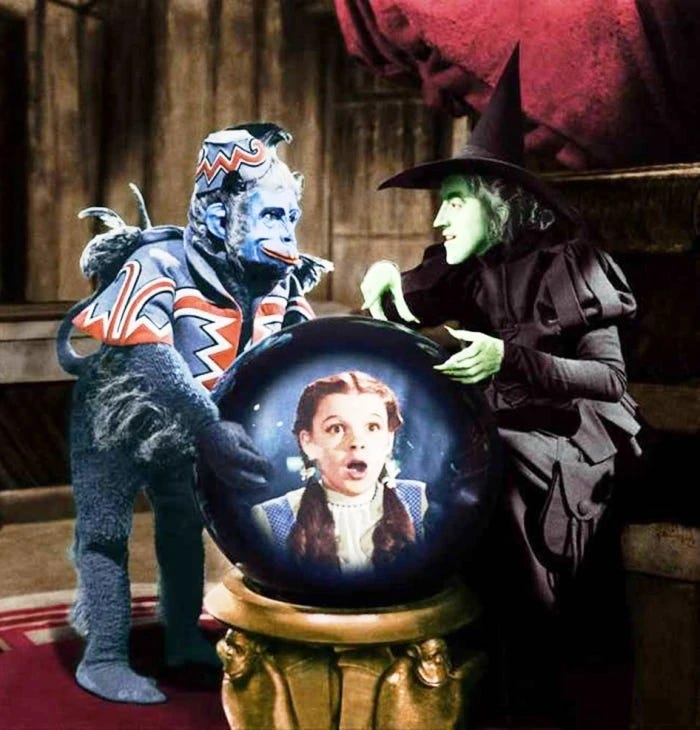
Though ultimately playing a much smaller role in the film than in the original book, the “Winged Monkeys” are for many Oz-fans the most memorable characters of the film, and play a crucial role in Dorothy’s journey through the “Land of Oz.”
These menacing creatures (more mischievous than evil), often described as “jungle monkeys with bird-like feathered wings wearing bell-hop hats,” constitute the “Wicked Witch of the West’s” aerial army, sent en masse to do the Witch’s bidding, like snatching Dorothy and “Toto” from the forest and bringing them to the Witch’s castle
.
Often spotlighting “Nikko,” Patrick Walshe, the head “Winged Monkey,” the scenes featuring these creatures are among the most suspenseful and dramatic.
Special effects director Arnold Gillespie employed several types of technicians to provide the illusion of flight, and enable the “Winged Monkeys” to imitate monkey mannerisms.
Winkie Palace Guards
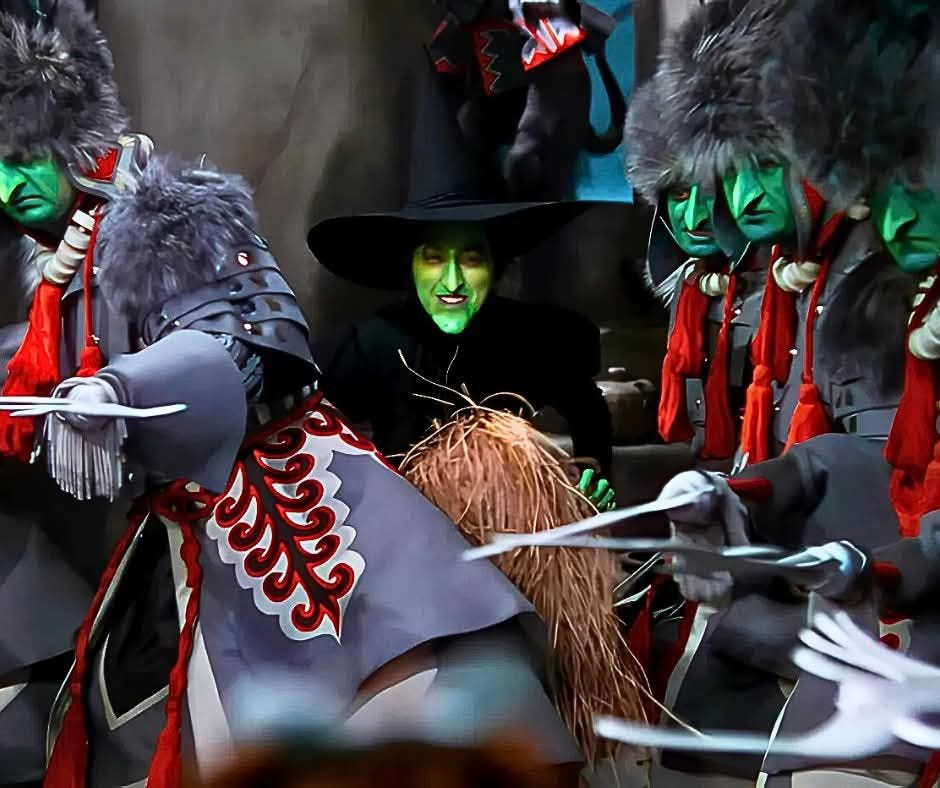
Memorable for their imposing militaristic uniforms, giant spears, green skin, and ominous chant, “Oh-Ee-Yah, Ee-oh-Ah! Oh-Ee-Yah, Ee oh-Ah! (otherwise known as the “March of the Winkies”), the “Wicked Witch of the West’s” foot soldiers/palace guards, the “Winkies” provide yet another level of menace to the “Wicked Witch’s power and seeming invincibility.
Soundtrack
For The Wizard of Oz soundtrack, MGM hired two giants of the songwriting business: the prolific American composer Harold Arlen, known for hits like, “That Old Black Magic,” “Come Rain or Come Shine,” and “Lydia the Tattooed Lady,” and renowned lyricist E. Y. “Yip” Harburg, famous for writing, “Brother, Can You Spare a Dime?” “April in Paris.” and “It’s Only a Paper Moon.”
For the accompanying score, MGM hired its own arranger/composer, Herbert Stothart (for which he won the Academy Award for “Best Original Score”).
In all, 21 songs were written for the film, including “Ding-Dong! The Witch Is Dead” and “The Lollipop Guild” (sung by the Munchkins Chorus), “We’re Off to See the Wizard” (sung by Judy Garland, Ray Bolger, Buddy Ebsen, and Bert Lahr), “If I Were King of the Forest” (sung primarily by Bert Lahr; but also Judy Garland, Ray Bolger, and Jack Haley), and of course the Academy Award “Best Original Song” winner, “[Somewhere]Over the Rainbow” (sung by Judy Garland).
“Over the Rainbow” ranks first in the American Film Industry’s “100 Years . . . 100 Songs,” and the Recording Industry Association of America’s “365 Songs of the Century.”
Television and Home Media
Since 1956, new generations of children and young-at-heart have enjoyed the magic of The Wizard of Oz via a medium that didn’t exist in 1939: television. That was the year MGM sold CBS Television the rights to televise the film at a fee of $225,000 per broadcast.
First shown on November 3, 1956, The Wizard was a huge ratings success, with a Nielsen rating of 33.9 and an audience share of 53%. When it was rebroadcast on December 13, 1959, it drew an ever larger audience (Nielsen rating of 36.5 and an audience share of 58%)—convincing the network that it should be an annual television tradition.
On October 25, 1980, the film was released on videocassette in both VHS and Betamax format by MGM/CBS Home Video, and made available to video rental shops around the US.
By the 90s, it was made available on laser disk; DVD in 2005; Blu-ray in 2009, Blu-ray 3-D in 2013, with a number of Box-Sets and Special Editions commemorating annual milestones.
Significantly, for the film’s 75th anniversary, an IMAX 3-D theatrical re-release was shown at 300 theaters across North America for one week, starting September 20, 2013, and on June 5 and 6, 2022, the film returned to theaters to celebrate Judy Garland’s 100th birthday.
Legacy
It’s difficult to measure the impact The Wizard of Oz has had on cinematography, film-making, culture, literature, theater, writing, video games, or even human imagination.
Famed film critic Roger Ebert chose The Wizard of Oz as one of his “Great Films,” writing, “The Wizard of Oz has a wonderful surface of comedy and music, special effects and excitement, but we still watch it six decades later because its underlying story penetrates straight to the deepest insecurities of childhood, stirs them and then reassures them.”
Similarly, San Francisco Chronicle film critic Mick LaSalle stated, “that the entire Munchkinland sequence, from Dorothy’s arrival in Oz to her departure on the yellow brick road, has to be one of the greatest in cinema history–a masterpiece of set design, costuming, choreography, music, lyrics, storytelling, and sheer imagination.”
There’s been an animated sequel, two Broadway musicals (The Wiz and Wicked), a DC Comics/Marvel Comics comic book adaptation, and a big-budget animated musical film, Legends of Oz: Dorothy’s Return, which follows Dorothy’s second trip to Oz.
A tribute to its extraordinary popularity, the 2024 marketing campaign for season 22 of American Idol is directly themed after this film–with a commercial featuring Ryan Seacrest, Katy Perry, Lionel Richie, and Luke Bryan as the “Tin Man,” “Dorothy,” the “Cowardly Lion,” and the “Scarecrow.”
Although most of the original costumes are on display at the Smithsonian National Museum of American History, many copies, memorabilia, and set pieces have been sold or auctioned off for exorbitant amounts of money, one of the five original pairs of Ruby Slippers (one not worn in the film) sold for over half a million dollars, while one of the six dresses Garland actually wore in the film sold for nearly $1.6 million in 2015.
Over the last 80+ years, dozens of fantasy films have drawn record numbers to the theaters (The Lord of the Rings trilogy, The Chronicles of Narnia: The Lion, the Witch and the Wardrobe, Labyrinth, the Princess Bride, to name just a few), but none have had the lasting impact of The Wizard of Oz. And it seems likely that none ever will.