Japan has had a history of intense political fragmentation, and its relationship with global trade networks and even outside contact in general has been tenuous. In the mid-sixteenth century, Christianity’s appearance inside Japan was inextricably tied to these facts. While the religion initially surged thanks to the support of powerful allies like Oda Nobunaga, it later faced challenges so severe that the community seemingly vanished from the country entirely.
Thus, the history of Christianity in Japan is marked by dramatic, unpredictable shifts that made adherence challenging and, sometimes, life-threatening.
Considerations such as political loyalty and the disdain of foreign influence exerted intense pressure on the church, and early missionaries shared both optimism and confusion about the future of Christianity in the country.
Francis Xavier, later sainted, said of the Japanese people, “The people whom we have met so far are the best that have yet been discovered… They are of good will, and eager to learn.” This initial hope that Japan might become a major center of Christianity in Asia was soon tempered, and the Tokugawa dynasty eventually saw any hope of Christian dominance snuffed. To understand why Christianity remains a significant minority in Japan, we must first trace the complicated path it took to get there.
Japanese Religion Prior to Christianity
Japan has never been a religious monolith, and its belief systems differ from many standardized sects the world over. The prevailing religion, Shintoism, focuses on the concept of “kami,” or spirits. The spirits of ancestors, animals, sacred places: all these and more largely make up a person’s awareness of the world.
However, Shintoism also carried a significant political lean in the past. Because the imperial family was thought to be descended from the sun god Amaterasu, politics and religion blended in one of the most concentrated forms of nationwide power.
But Shintoism was not the prevailing national religion. Rather, it was more a fact of life to be practiced alongside Buddhism in many cases.
Buddhism, which had been present in the country all the way back to the 6th century, rose to such heights that some temples exerted enough influence to change the politics around them. Some Buddhist groups even functioned like independent states.
In part, religion played an inescapable role in the Sengoku period, when the country fractured into its sects of power. Because institutions such as Buddhist temples and religious militias (ikko-ikki) carried such weight, some lords’ focuses landed squarely on breaking apart the influence of religion. This, too, impacted how Christianity would eventually be received.
The Arrival of Christianity (1540s to 1570s)
One of the most influential figures in Christianity in many parts of the world was Francis Xavier, and it was he who introduced Christianity to Japan in 1549. When the Jesuit arrived in Kagoshima as part of the Society of Jesus (an element of the Catholic Reformation), he found himself face to face with Japan’s Sengoku environment.
This era of civil conflict saw regional warlords competing for territory, resources, and recognition of authority. The country was politically fragmented, banding behind either those influential people whose cause they supported or simply the individual currently lording over their region. This fragmentation opened opportunities for foreign influence, such as merchants and, by extension, missionaries.
However, missionaries were just as like to encounter hostilities as welcome. Each region’s lords had their own ideas about whether Christianity was permissible, so adherents needed to find an ally in order to thrive in an area, and sentiments could shift quickly.
Despite this, Xavier noted that the Japanese people seemed, by and large, welcoming to the new ideas, though the language barrier remained a problem. “The language is very difficult, and we are unable to explain the mysteries of the faith without great labor,” he noted in a letter, dated 1552.
In an effort to expedite their work, missionaries sought the protection of regional lords so that they could devote their efforts to translating religious materials and studying Japanese customs as a point of reference.
But lords may not be easily convinced. Many missionaries resorted to partnering with Portuguese merchants, who brought firearms and other valuable goods. The promise of commercial connections sometimes encouraged rulers to tolerate the missionaries’ presence (or even, in some cases, to support it directly).
Over time, conversions to Christianity increased. By the 1580s, Jesuit records estimate that anywhere from 150,000 to 300,000 Japanese individuals had been baptized; since baptism is a process fraught with logistics, it is likely the number of converts was higher.
However, missionaries acknowledged that conversion was more complicated than it seemed. When a regional lord was baptized, many of his retainers would volunteer as well, potentially skewing the number of true converts based on the dogma.
In this way, Christianity in its earliest period was inextricably linked to regional power structures. However, the religion would soon see its surge with the rise of Oda Nobunaga. One of the most powerful leaders of the late Sengoku period, Nobunaga sought to unify Japan under his authority; that meant weakening any institutions that opposed his rule. That meant not just local lords, but the powerful Buddhist temples that had maintained the equivalent of their own armies.
Missionaries, on the other hand, lacked the military power to threaten him, but they had one thing in abundance: a desire to share their gospel. And for every one who turned to Christianity, one fewer sought the Buddhist teachings.
A combination of fracturing religious power in Buddhist traditions, the open welcome of Christianity by Nobunaga as one of the most influential political figures, and the missionaries’ ties to firearm trade all contributed to the surge in Christian presence in Japan by the end of Sengoku.
But there was a problem. After Nobunaga’s death in 1582, political power shifted again, and missionaries found themselves on the cusp of an important moment: whether new leadership would view them in the same way as their ally Nobunaga had.
Toyotomi Hideyoshi took up Nobunaga’s momentum to unify Japan, and on his way, noted the destruction of Buddhist temples under the influence of Christian conversion. Where Nobunaga had valued this trend, Hideyoshi saw an increasing foreign influence in the country.
Around the world, tales of the Philippines and the Americas rose as examples of imperial expansion, with missionaries sometimes preceding colonial rule. According to some accounts, Hideyoshi once questioned a Spanish sea captain about this pattern.
His suspicion grew. If missionaries had laid the groundwork for a political flip in other parts of the world, especially at the hands of foreign influences, why not in Japan? In 1587, Hideyoshi proclaimed that “it is not fitting that the evil law of the Christians be spread here.”
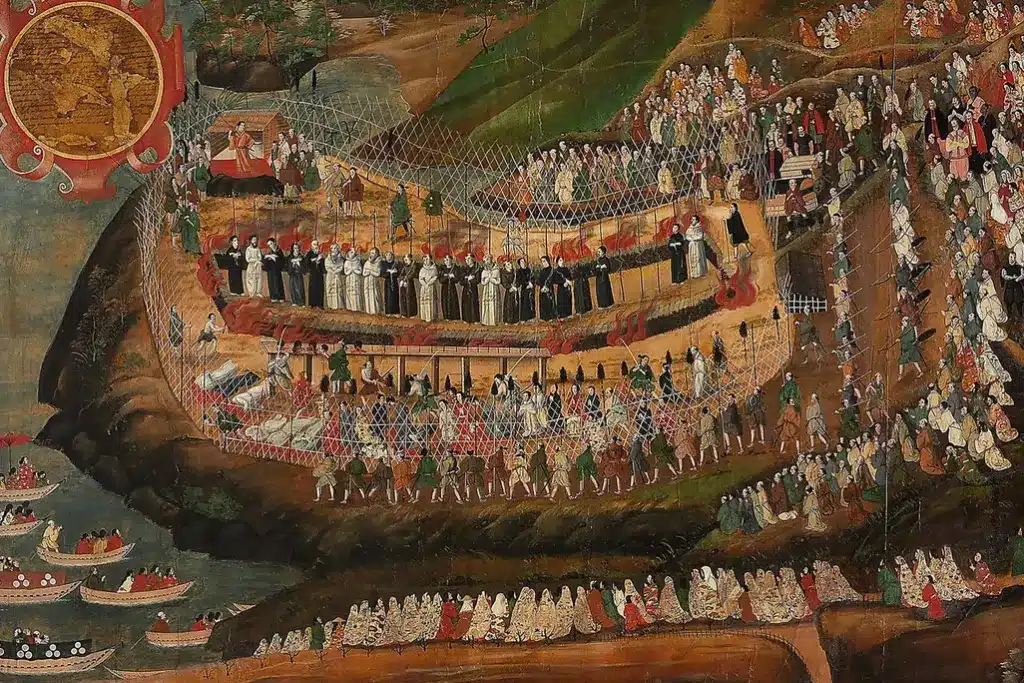
While enforcement of Hideyoshi’s rule was inconsistent, not all missionaries were able to continue their activities quietly. In 1597, 26 Christians were executed in Nagasaki (both foreign missionaries and native Japanese converts). In thematic resonance with the Christian narrative, they were paraded through several towns before being crucified on a hill.
For Christian communities, the death of these martyrs proved that the country’s sentiments toward Christians had changed in a permanent way. But the push against Christianity would only intensify.
The Banning of Christianity in Japan (1600s)
In 1600, Tokugawa Ieyasu claimed victory in the Battle of Sekigahara and rose as the dominant political figure in Japan. Within the next few years, he seized the position of shogun, establishing a military government that would persist for more than 200 years. At first, missionaries were tolerated within this regime. That did not last.
By 1614, the shogunate committed to the stance first laid down by Hideyoshi. Tokugawa’s ban on Christians demanded the expulsion of missionaries, the destruction of all their churches, and the seizure of any native Japanese converts deemed to be prominently influential.
While most foreign priests left the country during this time, a few remained to secretly support the underground communities where Christianity now had to operate.
To avoid the inconsistent implementation that Hideyoshi experienced, Tokugawa took a multi-pronged approach. One of the most famous options was fumi-e, literally “stepping on a picture,” to weed out Christians. Suspected believers were required to step on images of Christ or the Virgin Mary to demonstrate that they were not part of the Christian sect.
Additional options included temple registration, in which households were mandated to affiliate with the local Buddhist temple; this process was called danka. Each temple kept records confirming that residents were not Christians. Those who were outed experienced persecution, including imprisonment and even execution.
Tokugawa’s prohibition on Christian activities still allowed a sliver of support for the cause, and this single ember left unquenched proved to be a fatal flaw in the shogun’s treatment of Christianity.
A young leader named Amakusa Shirou rallied farmers oppressed by heavy taxation, as well as much of the Christian underground concentrated in the Shimabara Peninsula, into action. From 1637 to 1638, this rebellion (called the Shimabara Rebellion) stood openly against Tokugawa, raising banners bearing Christian imagery and slogans invoking protection at the hands of God.
Fortifying themselves at Hara Castle, the rebels resisted government intervention for several months. However, Tokugawa assembled an army and laid siege to the stronghold, forcing its fall in 1638. Tens of thousands of rebels were killed; one military record states simply, “The castle was taken, and none were spared.”
On the heels of this significant rebellion, Tokugawa was determined to squash the Christian sect for good.
Compounding factors, such as foreign influence, the consistent but difficult-to-find presence of Christians in Japan, and more prompted Tokugawa to develop the strictest policy to date. Overseas travel was restricted, foreign trade nearly eliminated, and when European merchants were allowed to enter, they had to do so from dedicated, pre-approved ports.
This period, called sakoku (literally “closed country”), marked the greatest strain Christianity had seen so far. The religion was officially declared illegal, and missionary activity was explicitly forbidden.
Within this context, kakure Kirishitan (literally “hidden Christians”) arose. Because they could no longer rely on priests or churches, these secretive communities adapted their practices to blend with cultural norms. For example, their valued religious images were disguised as objects that could be mistaken for those common in local traditions.
Due to the risk of discovery should too many Christians gather in the same place, these communities receded to isolated locations. With such separation between them and away from a centralized church, their Christian religious rituals gradually developed distinct identities independent even of each other.
The Reemergence of the Christian Tradition (1850s)
For centuries, Christianity existed on the fringes of political awareness, sparse and diverging from its roots in order to survive. But Japan could not stay closed forever. In 1853, a naval squadron led by Matthew Perry entered Edo Bay with four steam-powered warships. This American force carried a letter from the President of the US demanding that Japan open its borders to diplomatic and commercial relationships.
While Tokugawa initially declined Perry’s request, he returned the next year with an even larger fleet of ships. The pressure of the “Black Ships” in the bay proved too significant, and Tokugawa yielded. The 1854 Convention of Kanagawa, and the following Harris Treaty of 1858, marked the opening of two new ports to American vessels, and Japan entered the wider world dominated by Western superpowers.
Among the treaties that followed Perry’s expedition, provisions arose allowing foreigners to practice Christianity within the boundaries of their settlements. However, Japanese citizens remained legally forbidden from practicing. Still, the flexibility allowed missionaries to reestablish churches, and the influence of Christianity began to peek from the shadows once more.
Few events in Japanese history have been as impactful as the political upheaval in 1868, called the Meiji Restoration.
Power returned to the imperial court, ousting Tokugawa from his iron grip on the country and its religion. With Emperor Meiji’s focus on strengthening Japan as a modern nation-state through political connection across the world, the possibilities expanded.
Christianity remained illegal near the beginning of the post-Tokugawa regime, primarily because the fledgling government still feared further unrest and had learned from events like the Shimabara Rebellion. Pressure from the West, which criticized Japan’s treatment of converts, pushed Meiji to relent.
In 1873, the Meiji government finally removed the anti-Christian postings and officially lifted the prohibition against it. As expected, missionary activity surged afterward, with Catholic, Protestant, and Orthodox missions establishing churches, hospitals, and schools across the country.
Churches saw record numbers of visitors as underground Christians finally returned to centralized service. However, some groups chose to remain separate, maintaining the unique traditions they had developed during their centuries of isolation.
While Christianity flourished in a way that had been nearly forgotten, the effects of Hideyoshi and Tokugawa could not be easily erased. The religion never reclaimed the large-scale influence it briefly held under Oda Nobunaga in the 16th century.
Today, Christianity makes up one to two percent of the population. However, numbers can be difficult to ascertain, as Shintoism remains an influential factor that many families hold as a “given” in addition to other religious practices, such as Buddhism. Thus, soloist Christians may not be an entirely accurate metric. This also depends on whether only baptized members are counted.
Currently, the Roman Catholic Church, Eastern Orthodox Church, and some Protestant denominations (mostly Baptist, Pentecostal, and Lutheran, aside from the dominant United Church of Christ) make up the bulk of the religious practice. The Catholic Church was among the first to reclaim ground after Perry’s endeavors, followed by orthodoxy on the back of Russian missionary Nicholas of Japan.
Even though Christianity makes up such a small portion of the overall population, Christian imagery and customs have become more widespread. Christmas is widely celebrated, though in its own, locally cultural form and without many of the religious connotations.
Western-style weddings are also becoming more popular, reflecting much of the same church-adjacent imagery as in Christianity: white dresses, organ music in churches, and clergy-style officiants, regardless of whether the participants are Christian.
The Japanese approach to religion today is highly tolerant, providing Christianity with a secure place it has struggled to find in centuries past. For instance, many families may practice Shinto ceremonies for births or weddings while using Buddhist traditions for funerals.
Coexistence is common. Whether the religion will ever return to its pre-Hideyoshi heights remains to be seen, but given the current makeup of the country’s religious ideologies, it is unlikely that it will rise to the same level it did with Nobunaga actively centering it as part of politics.
Christians in Japan are currently free to practice, even if that practice is less concentrated in churches and more in widespread, latent traditions across the country.
Sources
Letter of Francis Xavier to the Jesuit Society in Europe, 1549: https://my.tlu.edu/ICS/icsfs/EurosinAsiaSources9pg.pdf?target=f95413e2-209d-4e7f-a324-456e70da7a3d
Edict of Toyotomi Hideyoshi, 1587: https://afe.easia.columbia.edu/ps/japan/tokugawa_edicts_christianity.pdf
Narrative of the Expedition of an American Squadron to the China Seas and Japan, 1856: https://www.loc.gov/item/01013865/