Few paranormal narratives are as widely known as The Conjuring. Made in 2013, the film exploded in popularity, earning more than $319 million off of a $20 million budget and spawning an entire franchise that continues into the 2020s. However, this haunting story of a dark entity attacking a family and possessing people did not come solely from the minds of its creators.
Part of what makes The Conjuring so compelling to cinephiles and casual watchers alike is the way it presents itself as based on a true story. Viewers are encouraged to treat the dramatization as one slightly fantastical glimpse into history. And yet, while the Bathsheba in The Conjuring is mere fiction, the reality of Bathsheba is much older, with multiple stories fueling the narrative.
To understand why director James Wan framed the concept of Bathsheba the way he did, we must first understand the historical and even biblical appearances of this legendary figure. The Conjuring was merely the culmination of multiple much older sources of inspiration.

Bathsheba in The Conjuring
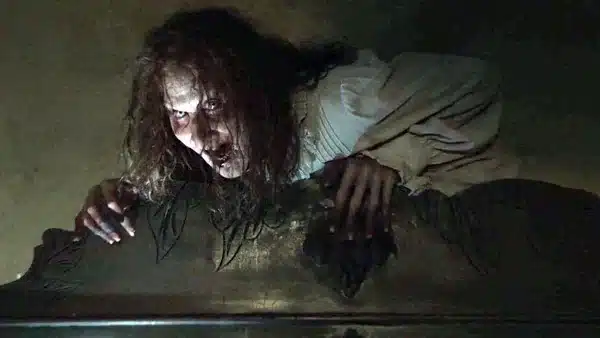
In the movie The Conjuring, Bathsheba is presented as a witch or malevolent ghost that possesses members of the Perron family. Over the course of the film, her story is unveiled as one of child sacrifice; Bathsheba killed her son as a sacrifice to Satan and then hanged herself so that she could continue to haunt the land as a curse.
When the Perron family moves into the property, the paranormal events begin. First, Bathsheba targets Carolyn, the mother of the Perron children, for possession. They call for the Warrens, a husband-wife duo and experts on hauntings, ghosts, and similar situations.
With the Warrens at their side, the group exorcises Bathsheba, discovering that she possessed Carolyn with the same goal as her own bloody history: to force the mother to kill her child as a sacrifice to Satan.
The Perrons were not a fictional family; Roger, Carolyn, and their five daughters moved into their Harrisville farmhouse in January 1971. Over numerous years, they reported unexplained events, including noises, shifting objects, and even feelings in their skin.
Carolyn Perron was the one who called for the Warrens, who had founded the New England Society for Psychic Research. While the film posits that all the events surrounding the haunting at the estate occurred within a relatively short time frame, the Perrons endured for around ten years before they left the property.
The film includes numerous narrative beats, including in the opening, that recount Bathsheba Sherman as a historically authentic satanic worshipper whose suicide was later confirmed, although these details are not supported by documentation.
The Rhode Island Bathsheba
The figure of Bathsheba in The Conjuring has stuck with many viewers years after they experienced the film, but some are not aware that Bathsheba was not an invention of the writing team’s imagination. The film alludes to Bathsheba’s connection to a real historical person, also named Bathsheba, who lived in Rhode Island in the mid 1800s.
This Bathsheba Sherman (formerly Thayer) became wrapped in local folklore as a witch who hanged herself after sacrificing her son; which son is not clarified, as she had multiple. Nineteenth-century New England fostered a cultural environment ripe for such rumors, even so long after the Salem witch trials.
This focus on witchcraft left the region primed with language that tied fear, misfortune, or even generalized social suspicion with the supernatural. Within this context, it was not uncommon for a person (and especially a woman) to become the subject of a story that only grew more extreme over time.
Add to this the prevalence of infant mortality at the time, and the rumors quickly found a subject on which to feast. In the 19th century, infant deaths remained common, with as many as 20% to 30% of children passing before their first birthday and nearly 40% by their fifth birthday.
Records indicate that Bethsheba and her husband Judson had four children: Julia, Edward, Herbert, and George. The deaths of multiple (Julia living from 1845 to ‘47, Edward from ‘47 to ‘48, and George from ‘53 to ‘56) corroborate the prevalence of child mortality, though US Census records indicate that Herbert did live to adulthood.
Combined with witch-forward thinking baked into the region’s history and identity, unusual events such as repeated child deaths in close sequence could fester into myth. Thus, The Conjuring builds upon this hearsay, though no historical evidence of convictions or crimes exists.
What historians do know about Bathsheba Sherman is that she was born in 1812 in Burrillville, Rhode Island. Her death in 1885 was not attributed to suicide; her obituary published in the Burrillville Gazette indicates mortality caused by sudden paralysis, which historians attribute to a stroke or related condition.
While she did live near the farmhouse in Harrisville that is depicted in the movie, allegations of her activities as a witch on the property are unverified. In fact, the Sherman Farm documented in historical records was a separate property in the same community as the Arnold Estate farmhouse (about a mile away), where the haunting allegedly took place. This home was listed for sale in 2025, and true to its publicity, the auction went live on Halloween.
Even church records push back against the local folklore. Bathsheba was baptized as a child and remained active in her local Baptist community, both as a Sunday school teacher and with various other church activities.
Rhode Island’s Bathsheba served as little more than local legend until her resurgence in 1973. Ed and Lorraine Warren, who were real people (Lorraine passed away in 2019), responded to the Perron family’s request for help in 1973, resulting in the surge in popularity of Bathsheba’s story at this time. Lorraine made a cameo appearance in The Conjuring and served as a consultant for the story, citing her lived experience from that visit in 1973.
The Warrens themselves reshaped the narrative from their first step onto the property. Their interpretation of the events drew significantly from Christian demonology, which tended toward framing ghosts as malicious forces rather than neutral figures. Thus, shifting the narrative from local rumors to demonic oppression became simpler, as reflected in the final film and its divergence from historic records.
Due to the sudden increase in interest in the original Rhode Island Bathsheba, the region experienced a surge in tourism. This came with numerous instances of Bathsheba’s original gravestone being defaced or otherwise vandalized. In 2023, a crowdfunding effort succeeded in replacing the damaged headstone.
Digging Deeper: Bathsheba as a Biblical Figure
While the Bathsheba Sherman of Rhode Island served as the inspiration for The Conjuring, the origins of the name Bathsheba trace back much further: all the way to the Old Testament of Abrahamic traditions. In this account, Bathsheba was no demon or witch, though her name quickly became associated with sin or immorality.
In the Bible (Second Samuel 11 and 12), Bathsheba was the wife of Uriah, a trusted soldier in King David’s army. While Uriah was away on a campaign, David glimpsed Bathsheba in undress while taking a bath and became tempted by her beauty. David committed adultery, resulting in Bathsheba’s pregnancy.
While Uriah remained with his compatriots, David sent the order to arrange for Uriah’s death. While the focus of the biblical story remains on David, Bathsheba’s name soon became synonymous with temptation and sin, even though she later gave birth to Solomon, one of the most widely known and beloved kings in the Old Testament.
Throughout history, Bathsheba’s role in this story has changed across cultures and sensibilities. Some portray her as the living symbol of temptation, emphasizing the moment David sees her for the first time. Others, especially in modern analyses, emphasize the imbalanced power dynamic in which David is a king and Bathsheba is a subject, reflecting David’s abuse of his authority. However, this shift toward the more modern sensibilities had not accelerated to the point that it overshadowed the negative connotations of Bathsheba by the time The Conjuring was produced.
Director James Wan noted explicitly that he chose Bathsheba in part because he liked the name. For many audiences, this historic figure’s name already faintly associates with transgression, even if they are unsure of the details. Thus, attaching the name to a film’s demon carries a story thousands of years in the past all the way forward to the present.
The Conjuring did not simply spring into being from the mind of its director, nor did it adapt a real Rhode Island historical account. Instead, it reshaped a local ghost story framed by a significant backdrop of Christian history and demonology to create a character that appears derived directly from history but truly transcends any of her roots.