
Last updated on March 17th, 2026 at 08:53 pm
When people think of conquering a mountain, Everest almost ubiquitously comes to mind. While it is impossible to know how many people have truly reached the summit, this journey has been documented repeatedly since 1953, when Sir Edmund Hillary and Tenzing Norgay proved that a successful summit was possible.
However, even the most experienced mountain climbers face an arduous trip should they attempt to climb, always a hair’s breadth from fatal situations. Unfortunately, the climb of Hannelore Schmatz was plagued by intense challenges, such as intensely frigid temperatures and thin air, that resulted in her unfortunate death.
Stories abound regarding the reality of Schmatz’s demise, including anecdotes that those who have encountered her body on the mountain felt unable to escape her gaze. Details vary, and the reality of her final resting position and kit have not been confirmed with indisputable accuracy. What remains certain is that Schmatz did succeed in summiting Everest; however, the descent proved just as dangerous as the path up, which is the case more often than many people realize.

Schmatz’s Ascent (and the Descent That Took Her Life)
In 1979, Hannelore Schmatz joined a West German expedition to Mount Everest. At this time, expeditions to Everest were still relatively rare, at least compared to modern climbing. A lack of forecasting equipment, less technologically advanced climbing gear, and the knowledge that rescue was all but impossible dissuaded the majority of potential climbers.
Schmatz herself approached the climb with no dearth of experience; her marriage to fellow climber Gerhard Schmatz in 1962 saw both of them travel together to conquer some of the most notoriously challenging summits in the world. These include Manaslu (in 1973), Tirich Mir (in 1975), and Lhotse (in 1977). All of these treks provided invaluable training and experience, not just in general mountaineering, but in the specific and challenging conditions of Himalayan peaks.
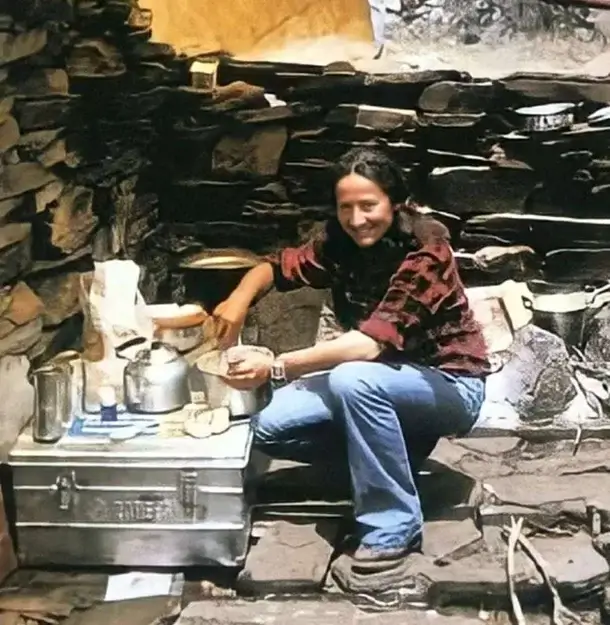
For those who dared to brave Everest, the summit was (and still is) not the end of the journey. Rather, it is barely the halfway point. Above 8,000 meters (26,247 ft) sits the area called the “death zone”: the final stretch to the summit, where conditions are so unfavorable that the body itself begins to shut down.
Temperatures drop so low that hypothermia is not entirely preventable in many cases, and the thin, oxygen-bare air can quickly lead to impaired decision-making, confusion, and slower movement.
Within this zone, climbers must both ascend and descend again, and they must do so quickly. Every minute matters. Thus, while Schmatz did reach the summit, the death zone proved too great a challenge on the way down.
On October 1, Schmatz’s husband Gerhard succeeded in his summit and returned to Camp IV. The next day, Hannelore summited Everest from the South Col route. Weeks of effort behind her, she faced exhaustion during the final, intense stretch of the climb. As she and her companions turned to descend, the day began to fade into evening, making the trek even more arduous in the failing light.
Her destination was also Camp IV, located directly on the cusp of the death zone at around 7,900 meters. At Schmatz’s side, American climber Ray Genet also began to struggle, and their pace slowed. Unable to go further, the two paused to rest with Sungdare Sherpa, their guide. These extra few hours would mean the difference between life and death on an expedition weeks long.
Not far from Camp IV (about 8,300 meters), Schmatz’s body could go no further. She sat down, unable to continue, and this proved to be her final mistake. Stopping to rest on Everest leaves the body exposed to frigid winds with minimal protection from the temperature, and without movement to produce heat, the body cools quickly. The longer a climber sits to rest, the harder it is to continue.
Some accounts suggest that one or more other climbers, potentially Yasuo Kato, discovered Schmatz (and her companion, Genet) during this time. Whether or not such a story is true, the harsh reality of mountain expeditions is that a single climber in distress can require too much effort to assist; offering help could doom numerous other climbers, who need every reserve of their own energy to survive. Schmatz’s descent, beset with oxygen-deprived confusion and physical failure, proved much more arduous than the trip to the summit.
Unfortunately for Schmatz, whether she was seen prior to her death or not, Everest’s intense temperature drops brought her to rest, where exhaustion prevented her from rising again, and hypoxia (a lack of oxygen) claimed her alongside hypothermia. Genet suffered the same fate, neither climber reaching Camp IV. Sungdare Sherpa did succeed in returning but suffered severe hypothermia that cost him his fingers.
Why Schmatz’s Body Remained
Ascent up Everest is risky at the best of times, and climbers are discouraged from making the trip at all for their own safety. Thus, when it came to the challenge of potentially retrieving Hannelore Schmatz from the place of her death just outside Camp IV, serious considerations needed to be taken into account.
Retrieving a body in the death zone required other climbers to risk their own lives. Even today, with modern gear, body recovery can require specialized teams and tens of thousands of dollars. This level of inherent risk was only more relevant in 1979. In fact, in 1984, a team of Nepalese climbers attempted to recover her body. Yogendra Bahadur Thapa and Ang Dorjee perished in the attempt, falling to their deaths.
Thus, Schmatz’s body remained where it rested on the south side of Everest. Due to her proximity to a common stopover point, she became a sort of waypoint marker. Other climbers described her as sitting upright, leaning against her backpack, which allowed her to be so visible.
From her death on October 2, 1979, Schmatz remained visible until the 1990s. At that point, it is believed that her body was swept off the ridge by strong winds, though some believe that fellow climbers obscured her body as a token of respect to the many eyes that had witnessed her final resting place for years.
Others report seeing her body as late as the early 2000s, but given that Schmatz was far from the only climber to succumb to Everest’s death zone (including her companion Genet), whether these reports accurately identified Schmatz or another climber is unknown.
thank you for making this article very useful and keep up the good work
thanks for good information